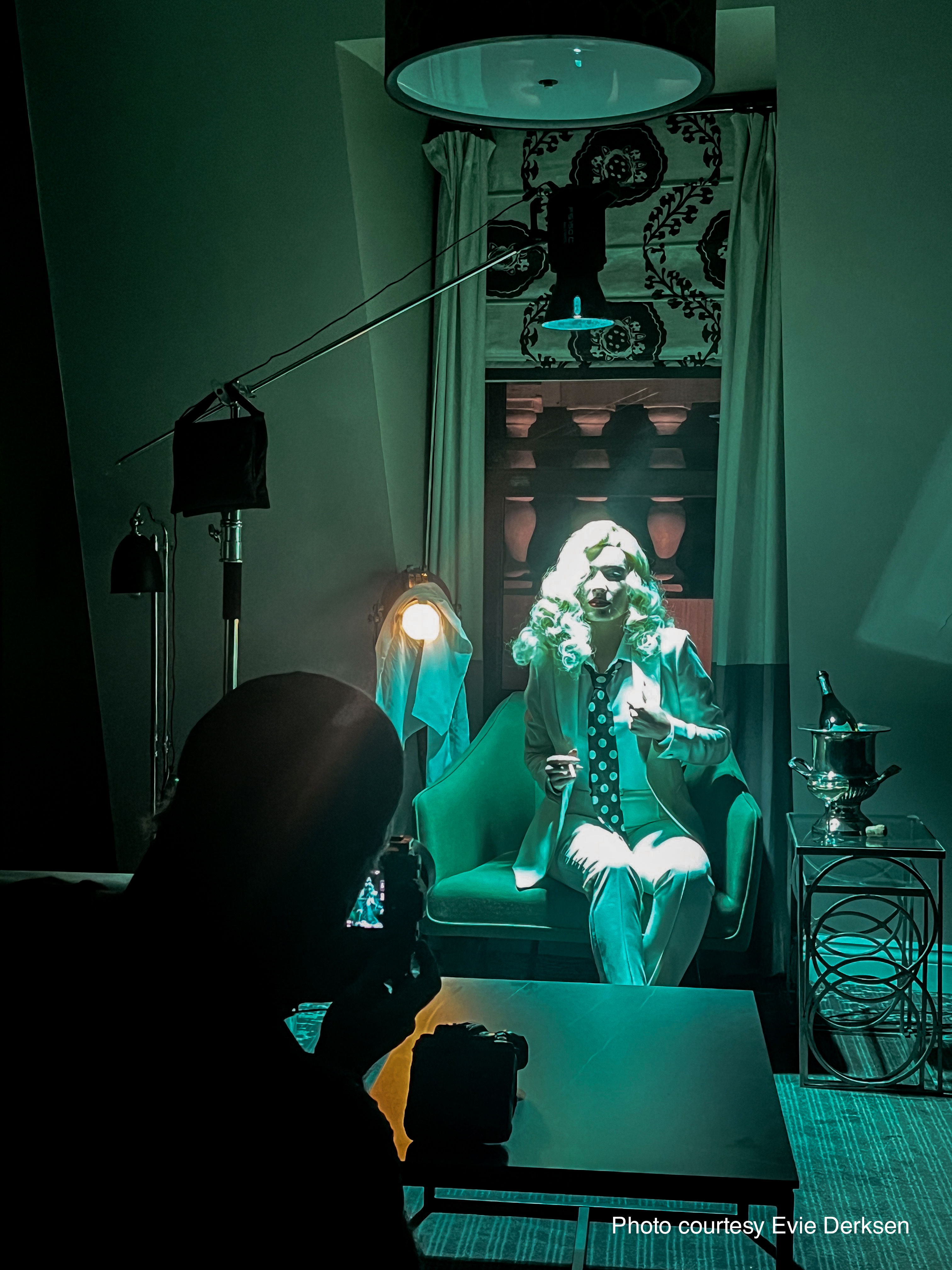
The Inchcolm Sessions: Reconstructing Hollywood Light February 8, 2026. Thomson Suite, The Inchcolm Hotel, Brisbane.

The question that kept me awake the night before was simple: How do you paint light you’ve never actually seen?
I’ve studied George Hurrell’s Hollywood portraits for years — analysed his lighting diagrams, read technical manuals from the studio era, studied vintage equipment specifications. I know intellectually that his signature look came from a specific Fresnel positioned at 45 degrees, a white reflector at camera right, and a hair light from above, creating that characteristic “stardust” separation. I can recite the inverse square law, explain fill ratios, and diagram key-to-fill relationships.
But knowing and witnessing are different things.
Before I could paint Hollywood’s golden hour, I had to build it.
I don’t try to imitate Hurrell — I admire his work enormously, but imitation isn’t the point. What I wanted was understanding. And that understanding had to be earned. In the weeks before the shoot, I’d been assembling props, jewellery, vintage perfume atomisers, and costumes collected over the years. I tested gear late into the night, wrote list upon list of things to remember, and packed the car with the kind of obsessive care that only makes sense to other people who work this way. By the time I was ready to drive to the location, I was already partly spent — mentally and physically drained from the preparations. There’s a particular pressure that comes with having a team relying on you for direction. You need either a solid plan or the presence of mind to abandon it gracefully. Ideally both.
The Mood Board: Building a World


Before a single photograph is taken, before a costume is pressed or a light stand assembled, there is the work of world-building — and the After The Golden Hour mood board is where that world first took shape. Conceived as both a creative bible and a myth-making tool, it distils the visual and emotional DNA of the entire project: the colour palette drawn from velvet curtains and gaslight gold, the cinematic tone of chiaroscuro borrowed from Hollywood’s studio era, the wardrobe that charts Evelyn St Claire’s transformation from luminous ingénue to spectral avenger. Every element — from the deep midnight of Theatre Noir to the dangerous warmth of Femme Fatale Red — was chosen not merely for aesthetics, but for psychological resonance. This document was prepared for the cultural historians, hair and makeup artists, and crew who would join the project, so that each collaborator could enter Evelyn’s world with the same emotional map. It is, in many ways, the heartbeat of everything that followed.
The Production Look Book: Where Concept Becomes Flesh


If the mood board is the soul of After The Golden Hour, the Production Look Book is its skeleton — the practical, detailed document that took a fictional character and gave her a wardrobe, a body, and a presence in the real world. Prepared for the Inchcolm shoot in February 2026, it catalogues ten outfits in meticulous detail: from the cream full-length wrap gown and the white gold Ralph Lauren evening dress, to the emerald Dida ‘Aphrodite’ silk satin and the navy blue velvet cocktail dress, through to the intimate foundation garments that nobody sees but that shape everything above them. Alongside the costuming, the look book contains the photoshoot manifesto — a declaration of intent that reframes the entire exercise not as documentation, but as an act of discovery. The question driving every decision wasn’t “Who is Evelyn St. Claire?” but the far more expansive “Who could she be?” The look book also includes an extensive inspiration section, analysing the work of Hollywood’s great portrait photographers — Hurrell’s dramatic chiaroscuro, Clarence Sinclair Bull’s intimate diffusion, the psychological complexity of portraits of Marlene Dietrich, Jean Harlow, and Lauren Bacall — not as images to replicate, but as a visual vocabulary to internalise and then transcend.
Why The Inchcolm
The Inchcolm isn’t just a beautiful heritage hotel. It’s a time capsule.
Designed by architect Eric P. Trewern and constructed in 1930 as Neo-Georgian medical consulting rooms, the building is exactly contemporary with the Hollywood studio system’s peak. When Hurrell was photographing Jean Harlow and Joan Crawford in his Sunset Boulevard studio, this building’s examination rooms were hosting their own theatre of bodies — medical rather than cinematic, but both spaces where physical presentation was scrutinised according to exacting professional standards.

The hotel’s conversion in 1998 from clinical space to hospitality mirrors Hollywood’s own transformation of women’s bodies: from private examination to public display, from medical gaze to commercial consumption. The building itself carries institutional memory of transformation as performance.
But what matters most for my purpose: the architecture is untouched. Original fixtures, preserved proportions, heritage finishes. The way light falls through 1930s windows, the texture of period walls, the spatial intelligence of rooms designed when bodies were objects of professional attention — all of this remains intact.
This isn’t a simulation. This is the real thing, preserved.


Reconstructing the Masters
I’d assembled a crew: model Heather Gurner, a skilled hair and makeup artist trained in vintage techniques, Christina from Diamond Diversity, and a small, trusted team with Evie Derksen.
We’d brought period-accurate costumes from my collection — an ivory satin evening gown, authentic 1950s foundation garments, opera pearls, vintage accessories. Not reproductions. The real materials that Hollywood’s cameras actually photographed.
The equipment: modern Fresnels (the technology hasn’t changed much), scrims, reflectors, flags, C-stands. Professional lighting instruments capable of recreating what Hurrell’s equipment did in the 1930s–40s.
Then the work began.

Hurrell’s signature portrait setup: Key light (Fresnel) positioned 45 degrees from subject, elevated slightly above eye line. Creates the characteristic shadow pattern — cheekbone definition, jawline sculpting, that quality of chiselled elegance that made his portraits iconic. White reflector camera-right, bouncing light back into shadows to prevent them from going completely black (he wanted mystery, not obscurity). Hair light from directly above and slightly behind, creating separation from the background and that luminous halo effect cinematographers call “stardust.”


Clarence Sinclair Bull’s approach: Softer, more diffused. Still directional, but gentler. He preferred wrapping light around his subjects rather than Hurrell’s more dramatic carving. Different scrim placement, different reflector angles. The results: less theatrical, more intimate. Compare his Gene Tierney portraits to Hurrell’s Crawford — same technical mastery, completely different emotional temperature.
We created variations of both setups. And then we watched what actually happened.
When the Shoot Rewrites Itself


Here’s something they don’t teach in any lighting manual: sometimes the model changes everything.
I’d arrived at the Inchcolm with a clear vision — the soft glamour of the 1950s, the Grace Kelly and Gene Tierney end of the spectrum. Wasp-waisted gowns, pearls, that particular brand of luminous, unthreatening femininity. I had the costumes, the lighting diagrams, and the reference images.
And then Heather walked in.
In a short while, it was clear that what I had planned and what I had in front of me were two entirely different things. Heather isn’t a dainty sweetheart. She’s bold, physically commanding, and carries an energy that is frankly a little dangerous. She is, in the most precise sense of the term, a femme fatale — and no amount of pearls and petticoats was going to change that.
I should say: I love femme fatales. I always have. There’s a richness to the archetype that I find endlessly compelling — these are women with depth, with agency, with an interior life that refuses to be contained by the frame. They are not two-dimensional. They are not decorative. The femme fatale is, in many ways, a fully realised character in a way that the passive ingénue never quite manages to be.

It’s worth remembering, too, that the femme fatale as a cultural construct was largely invented by men who felt threatened by female independence. The “dangerous woman” was a way of pathologising autonomy — of framing a woman’s confidence, sexuality, and self-possession as something predatory and suspect. I find that context fascinating rather than troubling, because it means that embracing the femme fatale is, in itself, a quietly subversive act. To paint her with admiration rather than warning is to reclaim something.
So when Heather walked in and it became clear that this was the energy we were working with, I didn’t hesitate.
So I stopped. And looked at the space differently.
What had been a controlled technical exercise became something else — a live creative problem. I began moving through the Thomson Suite and into the hallways, the stairwells, the period lift, reassessing everything with fresh eyes. Not just the physical architecture — the architraves, the doorways, the fall of light through original windows — but the psychological potential of each space. Where did shadow pool? Where did a corridor narrow into something ominous? Which angles felt like entrapment, which felt like escape? How could I use the geometry of this building to match, and amplify, what Heather was already projecting?

The finery didn’t disappear altogether — the ivory gown, the pearls, the vintage accessories were all still present. But the narrative shifted entirely. Instead of a portrait sitting, we were building something closer to a scene from a noir. The light that had been intended to flatter became light that implicated. The beautiful space became a space with a history.
The photographs I captured that evening were not the photographs I’d planned. In painting, there’s a term — alla prima — which refers to working directly and spontaneously, as opposed to building an image through a slow, methodical process. I love working alla prima. I love the nervous energy of it, the electricity of having to think on my feet, of trusting instinct over intention. Despite my preconceptions of what the shoot should have been, sometimes — just like life itself — you have to choose how you meet the wave. You can be the bottle, tossed about with no say in where you’re headed. Or you can be the dolphin — riding it, playing it, fully alive to the moment.
I know which I’d rather be.
There’s a particular kind of exhilaration that comes from having to create something out of what you actually have, rather than what you’d imagined. The uncertainty isn’t a problem to solve — it’s the fuel. You have to read the room, read the person, read the light as it actually falls rather than as you’d planned it to. Every decision becomes immediate and instinctive. And when it works, you know it in the moment.
I should note: my team was wonderful. But in those pivotal minutes of reassessment, I was alone with the problem in a way that’s difficult to fully communicate. They didn’t always see where my mind was going — which is no criticism; it simply reflects how solitary the core act of creative direction can be, even in a room full of people. It’s something I’ll bring them more fully into next time — taking them on the journey as it unfolds, rather than after the fact.
What Photographs Cannot Teach
Here’s what you cannot learn from studying vintage portraits, no matter how carefully:
How the light actually behaves in real space. How a Fresnel’s beam quality changes as you adjust its focus. How the reflector’s position shifts shadow density in ways that seem subtle but transform the image’s psychological impact. How period satin catches light with a character completely unlike modern fabric — something about the weave, the fibre content, the way it was manufactured creates an interaction with light that contemporary materials simply cannot replicate.

How a real body moves through these light fields. Heather wasn’t posing in the static sense — she was discovering where the light worked, where the shadows fell beautifully, where a slight turn of the head changed everything. This is embodied knowledge. This is what Hollywood’s actresses learned after thousands of hours in front of the camera: how to find the light, how to let it sculpt you.
How long these setups actually take. Hurrell wasn’t working quickly. Each portrait session was an extended collaboration, adjusting stands, refining angles, studying the results, adjusting again. Patience. Precision. Obsessive attention to millimetres of adjustment that create profound differences in the final image.
This is what I needed to understand. Not just the theory, but the practice. Not just the formula, but the feel.
From Knowledge to Canvas
The photographs we captured that day are reference, yes. But they’re not what I’m painting.
What I’m painting is the knowledge I gained — the physical understanding of how these lighting setups create psychological effects, how specific technical choices generate specific emotional responses, and why Hurrell’s portraits possess depth that superficial glamour cannot achieve.
When I’m at the easel now, I’m not copying photographs. I’m painting from compound understanding: historical research + material authenticity + technical reconstruction + embodied experience. My hand knows what the light should do because my body witnessed it doing exactly that, in a period-appropriate space, with historically accurate materials.

Oil paint allows subtleties that photography cannot achieve. I can adjust colour temperature in ways film stock never could. I can build atmospheric depth through glazing that creates dimensional presence beyond what any lens captures. I can slow down the moment, hold it suspended, let it breathe in ways the camera’s instant cannot.
The Inchcolm session gave me the foundation. The paintings will give me the translation — from light captured, to light remembered, to light recreated in pigment and oil, existing now not as ephemeral illumination but as permanent material presence.
What We Built

By the evening’s end, we’d captured nearly 500 photographs. Thomson Suite, the heritage hallways, the preserved stairwell, the period lift. We’d built and rebuilt lighting setups, studied how they behaved, and internalised their logic.
But what we really built was understanding.


I left the Inchcolm that evening with something I couldn’t have acquired any other way: the lived experience of Hollywood’s lighting intelligence, embodied and internalised, ready to inform the paintings I’m making now.
This is how archaeology becomes art. Not by studying artefacts from a distance, but by recreating the techniques that produced them, embodying the knowledge systems that gave them meaning, then translating that lived understanding into contemporary work that honours both the intelligence of the original and the complexity of our current moment.
The paintings are coming.
But first, I had to see the light.
Next in this series: “The Costume Archive: Authenticity in Every Thread”
After The Golden Hour opens November 7, 2026 at HOTA, Home of the Arts, Gold Coast. A selection of photographs from The Inchcolm Sessions will be on display — come and see the light for yourself.
